Our AI Approach

We don’t just claim it, we show why the number is right.
The AI first decides how a part should be planned — and only then with what.

What makes the demand for parts so difficult to predict?

Spare parts demand doesn’t follow an even pattern. Generic forecasting tools expect a steady curve and fail on exactly the parts that matter most. Most spare parts have no pattern to forecast in the first place.
That’s why PartsOS doesn’t start with the method, but with the question of how to plan a part at all.

First the class, then the method

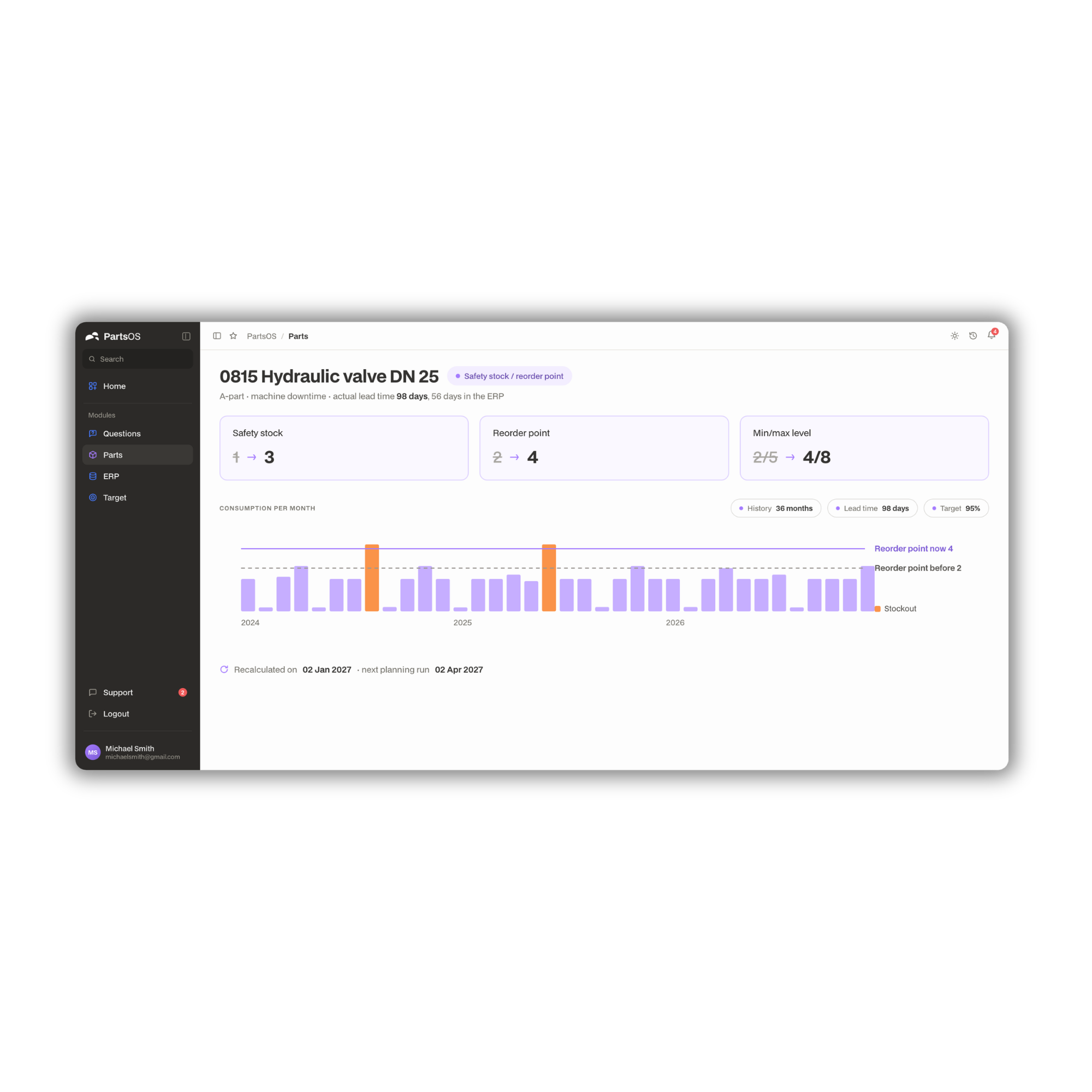
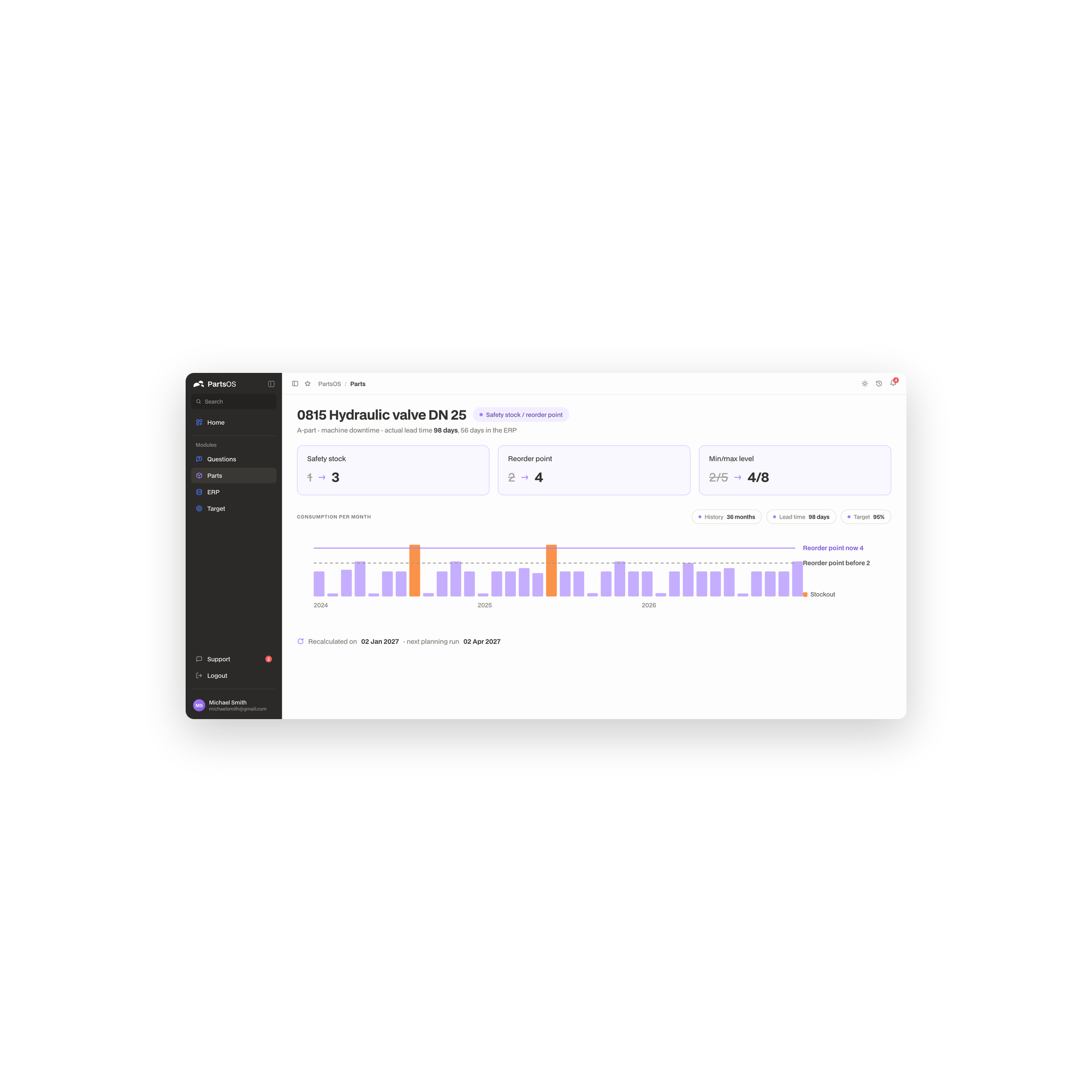
PartsOS decides how a part should be planned before it decides what to plan it with. Every part is assigned a planning class first. For forecast parts, more than 52 methods compete, and the most accurate one wins. For everything else, safety stock and reorder point come straight out of consumption history, lead time and your target availability. Either way, you can see how the number came about: which class, which method, why.
Tested, not guessed.

For every part in the Forecast class, more than 52 statistical forecasting methods are tested against your own withheld consumption history.
The method with the smallest forecast error wins. For all other parts, safety stock and reorder point are calculated directly from history, lead time, and your target availability.

Play

The best model is just the beginning

What you actually see for each forecast
and what you can rely on.

  • A clear, substantiated statement

    A clear, substantiated statement

    Every forecast shows two things: the extent to which it deviates from your previous consumption, in actual euros, not just as a numerical value and how reliable our method has been for that specific part in the past (Previous Accuracy, ranging from "Weak" to "Very Good"). A significant deviation combined with high reliability is a genuine signal. When reliability is low, it is worth taking a closer look.

  • Questions about a forecast?

    Questions about a forecast?

    Ask the PartsOS agent; it will show you which history it used, which methods it tested, and why the chosen model won. No made-up reasons, no machines.

  • How reliable this forecast is

    How reliable this forecast is

    Every forecast comes with its own metric: how well our method would have predicted this item over the past 12 months, expressed as a percentage from 0 to 100, ranging from "Weak" to "Very Good." This indicates how predictable the item is in general, not whether the current figure is correct.

You retain control

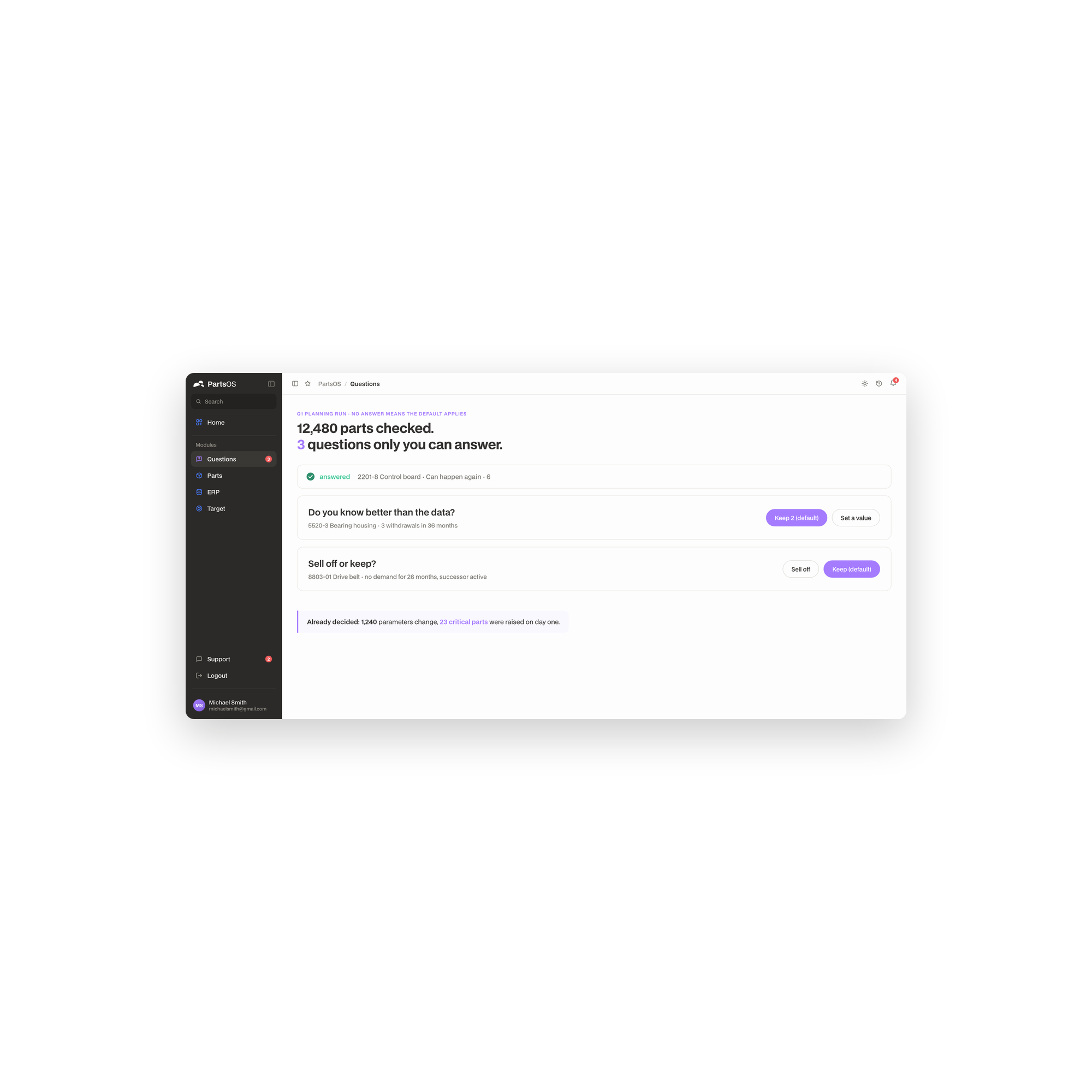
Nothing happens automatically. PartsOS plans your portfolio through and only brings you the parts where a decision is genuinely yours to make.
Whatever you reject stays as it is — and doesn’t come back in the next run.

Your data remains your data

More about AI in PartsOS

Not Every Wrong Forecast Costs the Same: The PC-Index Explains Why

Two parts, the same percentage error, a completely different amount of damage. Why a forecast shouldn't be judged by how wrong it was, but by what being wrong would have cost.

How PartsOS Decides Which Parts a Planner Actually Needs to Review

A single planning cycle can contain a thousand forecasts. How the system automatically sorts what can be approved right away, what can wait, and what genuinely needs a look.

FAQs

  • How does PartsOS ensure forecast reliability?

    Over 52 forecasting methods are tested against your specific historical data for each part; the method with the lowest error rate wins. That applies to parts in the Forecast class; for all others, we validate safety stock and reorder point against last year.

  • How are forecasts explained in PartsOS?

    Each forecast displays two values: the deviation from your previous consumption in actual euros, and the past reliability of our method for this specific component, expressed as a percentage ranging from "Weak" to "Very Good." Together, they provide more insight than a single, unexplained figure.

  • What data does PartsOS use beyond simple sales history?

    Replacement chains, outlier detection in consumption history, and - where available - additional master data fields such as lead time or stock levels further refine every forecast.

  • Does PartsOS automatically push data to my ERP?

    No. PartsOS gives you a parameter file; whether you take it into your ERP is your decision. Nothing is overwritten without your export.

  • Do I have to repeat a forecasting decision every cycle?

    No. A rejected or accepted forecast does not reappear in the next cycle unless there is a significant change.

  • Does exporting from PartsOS incur additional SAP costs?

    No. Exporting is a one-click, SAP-ready process; nothing needs to be manually re-entered, and there are no additional SAP licensing fees.

  • Do I have to review each part individually?

    No. PartsOS plans the portfolio through and only presents the parts where a decision from you is needed.

  • What is the PC Index?

    It prices the forecast error in euros rather than percentages, based on a retrospective analysis of your own sales history, indicating the actual cost of a deviation, not just its magnitude. We use it to select the best method and to compare ROI; the reliability of an individual forecast is displayed separately as "Previous Accuracy."

  • What does "Previous Accuracy" mean?

    Previous Accuracy indicates how well our method would have predicted this item over the past 12 months—expressed as a percentage from 0 to 100 and rated from "Poor" to "Very Good." A high value means you can rely on the forecast. A low value does not mean we made a poor choice; rather, it indicates that the item is inherently difficult to predict—and that is precisely what makes it worth a closer look.

  • Does the AI approach apply to every part?

    Yes, but not in the same way. Every part first gets a planning class. Only for Forecast parts do the 52-plus methods compete against each other; for the large majority, PartsOS calculates safety stock and reorder point directly.

We’re here for you

Every company is different. What matters to us are your specific challenges. Let’s discuss your untapped potential.

Any questions?

We respond to your inquiries, questions, or comments within 24 hours.

Is PartsCloud the right fit for you?

Let’s find out together! Schedule a no-commitment initial consultation to learn more about our offering and the potential for collaboration.