What does tied-up capital in inventory mean?
Every part on the shelf has been paid for before it is sold. Until it leaves the warehouse, that money is tied up. It can't be invested or used to repay loans, and it creates ongoing costs: cost of capital, storage space, insurance, handling, shrinkage, and the risk that a part will never be needed again.
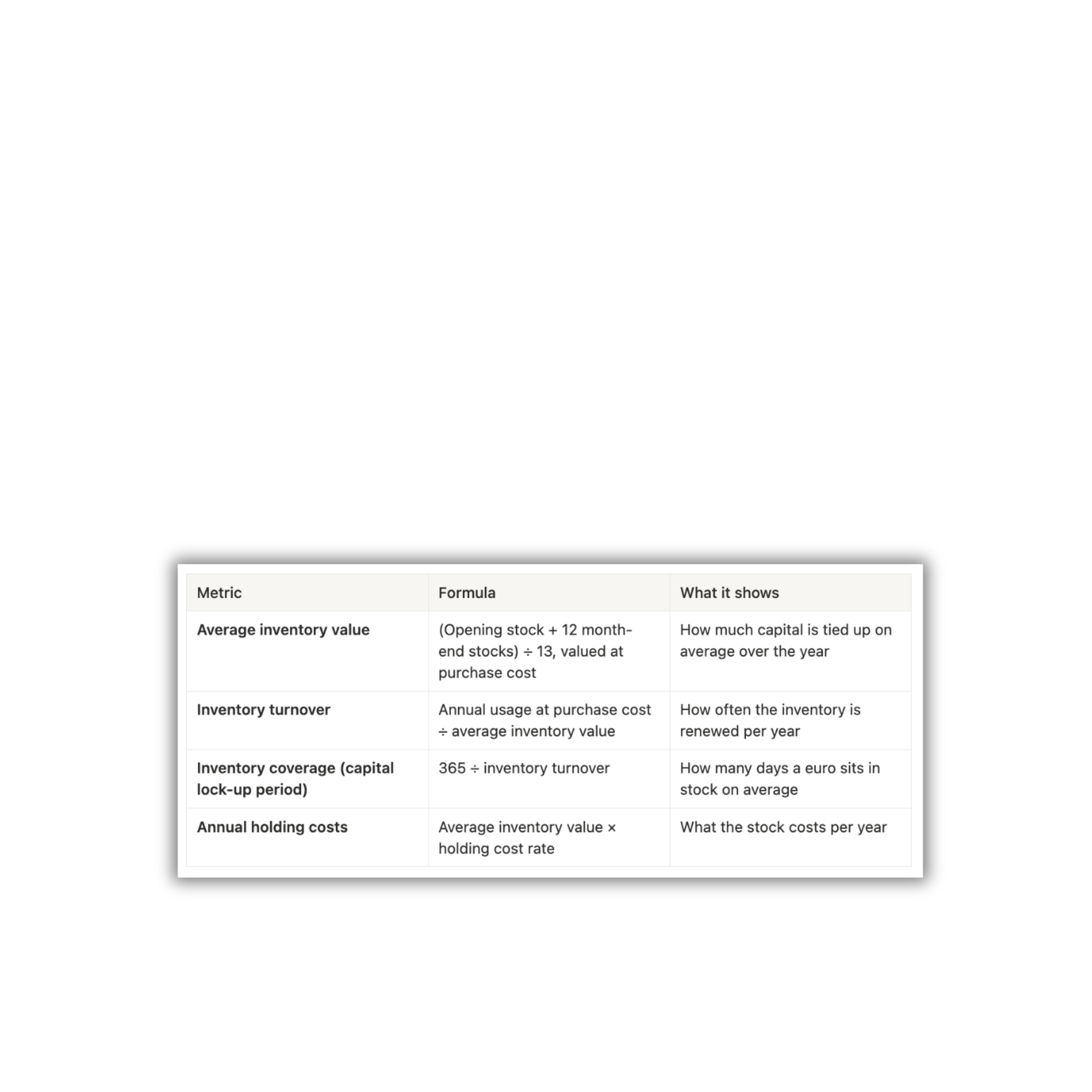
For management, three figures matter:
- How much capital is tied up: the average inventory value.
- How long it is tied up: inventory coverage, or capital lock-up period.
- What it costs per year: holding costs.
How much capital do machine builders hold in inventory?
The latest financial statement statistics from the Deutsche Bundesbank (May 2026) cover the balance sheets of 2,696 German mechanical engineering companies. Results for 2023:
- 36.3 % of total assets are inventories, almost five times as much as cash and bank balances at 7.7 %.
- For companies with €2 to 50 million in revenue, the share is as high as 42.5 to 44.0 %.
- Across the companies covered, that is roughly €60.9 billion in inventories.
Inventories include raw materials, work in progress, finished goods and spare parts. The statistics don't report spare parts separately, but they show the size of the lever: for many machine builders, inventory is the largest single item on the asset side.
How to calculate tied-up capital: the key formulas
The holding cost rate combines all costs of holding stock as a percentage of inventory value: cost of capital, storage space, insurance, handling, shrinkage, and obsolescence. In APQC's benchmarking database of 6,468 companies, the median is 10.0 % of average inventory value per year, across industries. Your own rate depends mainly on your cost of capital and how many parts end up scrapped or written down.
Worked example: what a spare parts warehouse costs per year
A machine builder has the following figures for its spare parts warehouse:
- Average inventory value: €3,000,000
- Annual usage at purchase cost: €4,500,000
- Of which parts without a single issue in the last 12 months: €900,000
This gives:
- Inventory turnover: €4,500,000 ÷ €3,000,000 = 1.5 per year
- Inventory coverage: 365 ÷ 1.5 = about 243 days, roughly 8 months
- Holding costs at 10 %: €300,000 per year, i.e. €25,000 per month
- Holding costs at 20 %: €600,000 per year
- Cost of the parts without any issue alone: €90,000 per year at 10 %, €180,000 at 20 %
The last figure is the most interesting. It is money spent on parts nobody needed last year. How much of it you can actually reduce depends on which of those parts still have to be held, for example because their absence would stop a customer's machine.
Why spare parts warehouses tie up so much capital
How to find out where your capital sits
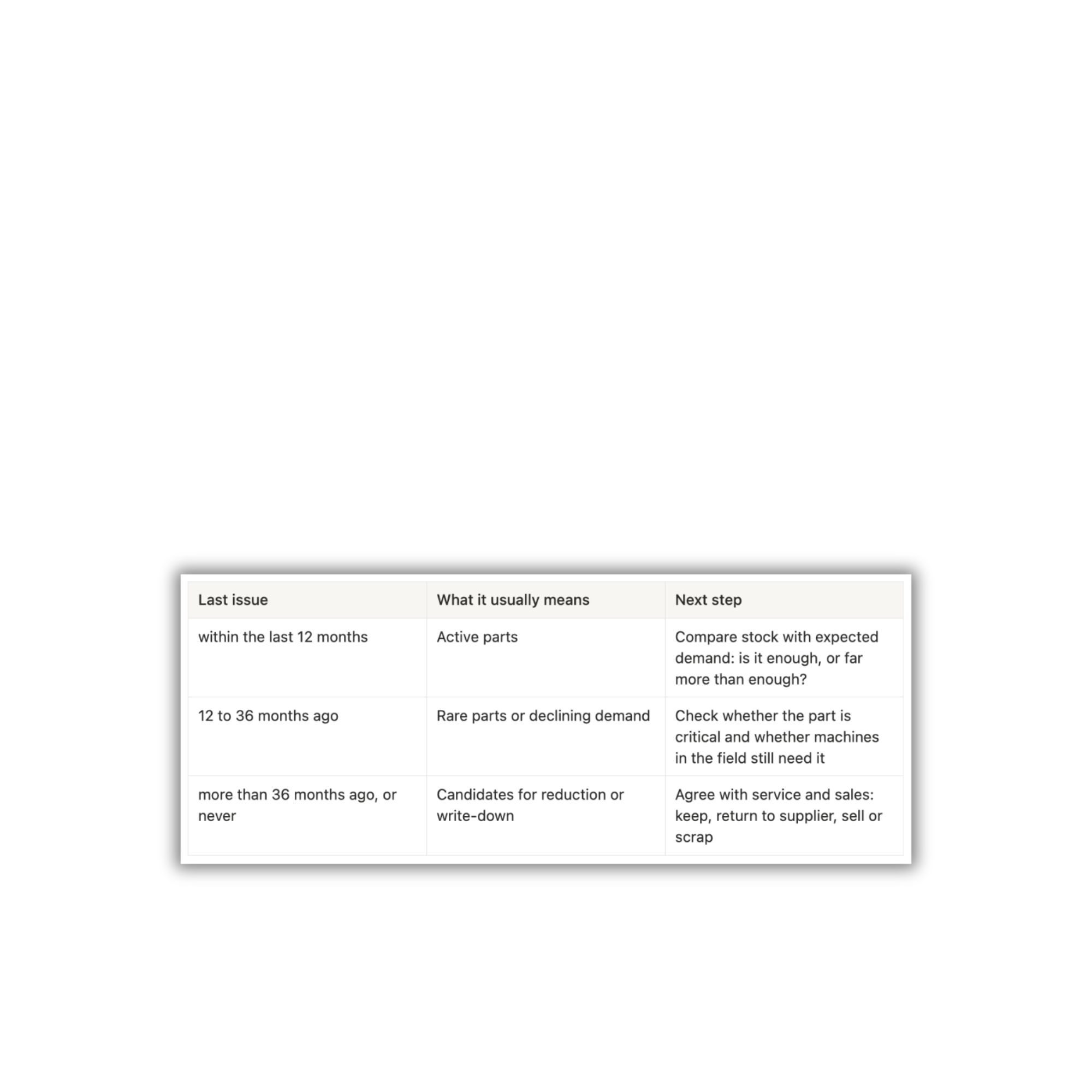
For a first overview, an ERP export with four fields per part number is enough: current stock, purchase price, date of last issue and usage over the last 36 months. Then split the stock value by time since the last issue.
Even this rough split usually shows that a large share of inventory value sits in parts that are rarely or no longer needed.
Reducing holding costs without hurting availability
Across-the-board cuts by a fixed percentage are risky. They hit parts without demand just as hard as parts whose absence stops a customer's machine. It is more effective to reallocate capital: away from parts nobody needs, towards parts that are needed.
- Measure stock per part against expected demand. The key question isn't "How much is in stock?" but "How long will this part's stock last at expected demand?". That requires a demand forecast per part number, not just the historical average.
- Don't stock every part. Parts with very rare demand and an acceptable lead time can be sourced to order. They only tie up capital once an order comes in.
- Set safety stock per part, not across the board. The buffer should reflect how much a part's demand fluctuates and what a shortage costs.
- Base last-time buys on data, not gut feeling. How many machines are still in the field, and how has demand developed in recent years? Both questions can be answered before a discontinuation.
- Tackle old stock actively. Parts without demand and without machines in the field don't become more valuable. Returning them to suppliers, selling or scrapping them frees up space and attention.
- Value errors in euros. Too much stock costs holding costs; too little costs revenue and customer trust. Only when both are on the table in euros can you decide where capital does the most good.
In practice: EUCO Rail
EUCO Rail is a specialist provider of maintenance and service solutions for rail transport and runs its own workshops. One of its central challenges before the project with PartsCloud was exactly the pattern described here: capital tied up in overstock while critical components were missing at the same time. On top of that came largely manual planning and no cross-site transparency over stock and demand. The project started with a complete analysis of the item master at part-number level: which parts are needed how often, which are critical for vehicle availability, which have long lead times? Every forecast is reviewed and released by the EUCO Rail team before it feeds into procurement.
Where PartsOS Forecast fits in
PartsOS Forecast creates a demand forecast for every part and shows what it means in euros. PartsOS does not place orders. Released forecasts go to your ERP as demand, and your MRP keeps working with its own rules.
- Coverage per part: PartsOS estimates how many planning cycles a part's current stock covers at forecast demand. This shows where stock lasts much longer than needed.
- Tied-up capital compared: for every part, PartsOS compares the winning forecasting method with your current method in a backtest, including average tied-up capital and availability.
- Your holding cost rate counts: you set what holding stock costs per year and how much unmet demand is actually lost for your company. Every forecast's valuation in euros is based on these settings.
- Make-to-order planning: PartsOS identifies parts that aren't worth stocking and plans them to order.
Frequently asked questions
-
What does tied-up capital in inventory mean?
Tied-up capital in inventory is the money sitting in stock until parts are sold or used. During that time it isn't available for other purposes and creates costs for capital, storage space, insurance, handling and obsolescence.
-
How do you calculate the cost of tied-up capital?
Annual holding costs = average inventory value × holding cost rate. With an average inventory value of €3,000,000 and a rate of 10 %, that is €300,000 per year.
-
What is a typical holding cost rate?
The rate depends on the cost of capital, storage space, insurance, handling, and obsolescence. In APQC's benchmarking database of 6,468 companies, the median is 10.0 % of average inventory value per year. Companies with a high obsolescence risk should calculate their own rate.
-
What is the difference between inventory turnover and inventory coverage?
Inventory turnover shows how often stock is renewed per year: annual usage divided by average inventory value. Inventory coverage shows how many days stock sits on average: 365 divided by inventory turnover.
-
How can you reduce holding costs without hurting availability?
By reallocating capital instead of cutting across the board: measure stock per part against expected demand, source rarely needed parts to order, set safety stock per part and reduce old stock that no machine in the field needs.
-
Does slow-moving stock have to be written down?
Under the lower-of-cost-or-market principle in German commercial law (§ 253 (4) HGB), inventory must be valued at the lower of cost or market value on the balance sheet date. In practice, hard-to-sell stock is often written down through slow-moving allowances, which reduce annual profit.
-
Sources
- Deutsche Bundesbank (2026): Financial statement statistics (ratios), May 2026, table I.4o Mechanical engineering, all legal forms, comparable sample 2022/2023. bundesbank.de
- APQC: Inventory carrying cost as a percentage of inventory value, Open Standards Benchmarking, Measure ID 100784, accessed 7 Oct 2026. apqc.org
- § 253 (4) German Commercial Code (HGB). gesetze-im-internet.de